
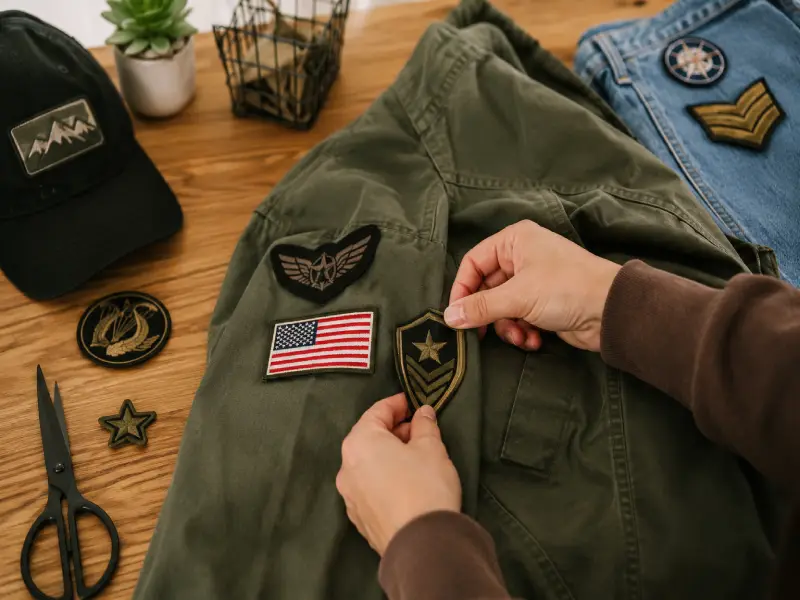
How To Turn Military Patches Into A Statement
Nobody reads the label on your jacket. They read the patch. It happens fast: someone’s eyes land on a sleeve, a chest pocket, a bag strap, and in that half-second, they’ve already picked up a signal. A veteran’s collection tells a different story than a small business uniform, and a team jersey tells a different one again. But strip away the context, and every patch is doing the exact same job: saying something about who’s wearing it, without anyone having to ask.
That’s the part that gets overlooked when a patch is treated as an afterthought, something to fill a blank space rather than something that actually earns its place. The good ones don’t feel bolted on. They feel like they belong there.
Why a Small Morale Patch Carries So Much Weight
There’s a reason armies figured this out centuries before marketing did. On a battlefield, you don’t have time to ask who’s who. You need to know at a glance. That’s exactly why military insignia became standardized in the first place: unit patches let soldiers identify rank, division, and role in the middle of chaos, when a second of confusion could cost something real.
That instinct never really left us. A patch still works as shorthand today for belonging to a team, for having earned something, for being part of a group that outsiders can’t just walk into. It’s identity you can see from a distance, no explanation needed.
Which is exactly why the design of a patch matters so much more than people expect. A cluttered patch reads as noise. A clean one reads instantly, and that instant read is the entire point. So the real question becomes: what actually separates a patch that works from one that just sits there?
What Makes a Patch Actually Look Good
Most people don’t realize this until they’re holding a bad patch in their hands. It’s rarely the design that fails. It’s the execution.
Thread and stitch quality
Good embroidery patches Canada production starts with thread density, the first thing worth checking. Thin stitching looks flat and fades fast, while tighter thread coverage gives a patch a raised, textured look that reads as quality even before anyone gets close enough to study it. Stitch count matters just as much: too few stitches and fine details blur into a blob; too many and the fabric puckers.
Backing that actually holds up
This is where a lot of patches quietly fall apart. Iron-on backing works fine for light use, but anything going on gear that sees real wear needs a sew-on or Velcro backing that can actually hold up over time.
Color that doesn’t fade
Colorfastness is the last piece of thread that holds its shade through sun, wash, and weather instead of dulling after a season. This is where sourcing starts to matter, using materials built for the actual climate here rather than something shipped in bulk and hoping for the best. A great design on cheap thread still ends up looking cheap.
The Fun Side: Morale Patches
If you’re hunting for the best morale patches ideas, the fun ones aren’t about rank or belonging to something official. They exist purely because they’re funny, or because they say something a uniform patch never could.
Morale patches grew out of military culture but went way beyond it. Velcro backing turned them into something you swap out depending on mood, mission, or who you’re trying to make laugh. Walk into any gear shop, and you’ll see rows of them, each one competing for a split-second read.
That split-second is everything. The strongest ones tend to follow the same rules:
Bold, simple text:
Readable at a glance, not a paragraph crammed onto fabric
One strong icon or symbol:
Not five competing for attention
Humor that lands fast:
Inside jokes work, but only if the punchline is quick
High contrast colors:
So it doesn’t disappear against dark gear
What’s worth knowing is that a lot of the same manufacturers producing serious insignia also handle this side of things. Formal unit patches and humor patches often come from the same production line, which is exactly why trusted custom military patch suppliers tend to be good at both, not just one.
Beyond the Military: Patches for Teams and Businesses
A lot of custom military patch makers in Canada also serve sports teams and small businesses, and that overlap makes sense once you look at why. Patches stopped being a military-only thing a long time ago. Sports clubs, small businesses, and local teams have quietly picked up the same idea because identity works the same way on a jersey as it does on a uniform.
Why teams are switching
A full custom-print jersey run is expensive to redo every time a sponsor changes or a roster shifts. Patches solve that problem. A team can keep the same base jersey for years and just swap the patch when something changes, instead of reprinting everything from scratch.
That’s part of why so many clubs are choosing to improve team jerseys in 2026 with patches instead of full reprints. It’s cheaper, faster to update, and gives a team the flexibility to mark milestones, such as a championship year, a new sponsor, or a roster change, without touching the rest of the kit.
Where the overlap comes in
The equipment, the stitching process, and the attention to durability barely change based on who’s ordering. Only the artwork does, which is exactly why manufacturers built around military-grade standards make sense for teams too.
Ordering Patches Without the Guesswork
Getting a patch made sounds simple until you’re actually doing it, and then the questions pile up fast. A little groundwork before placing an order saves a lot of back-and-forth later.
Start with quantity
Most suppliers set a minimum order, and it’s usually higher than people expect. Ordering in bulk from custom military patches Canada services almost always brings the per-unit cost down, so it’s worth checking that number before finalizing a design, not after.
Check the timeline
Turnaround time varies a lot depending on design complexity and thread colors used. A simple two-color patch moves fast. Something with fine detail or metallic thread takes longer, so it helps to ask up front rather than assume.
Ask for a sample proof
This step gets skipped more than it should. A proof shows exactly how the stitching, colors, and sizing will look before the full run gets made, catching problems while they’re still cheap to fix.
Pick the right backing
- Iron-on for light, occasional use
- Sew-on for gear that sees regular wear
- Velcro for anything that needs swapping often
Where it’s made matters too
Sourcing locally through online stores for embroidery patches in Canada usually means better quality control and faster shipping than overseas runs, where communication gaps and long transit times tend to cause more problems than they solve.
Mistakes That Make Patches Look Cheap
Most cheap-looking patches didn’t start out that way. They started as a decent idea that hit one of these problems along the way.
Mistake 01: Cramming too much in
A patch only has so much space, and trying to fit a full logo, tagline, and detailed artwork into two inches usually backfires. Fine details blur together once stitched, and what looked sharp on screen turns into a smudge on fabric.
Mistake 02: Too many colors
Every color added means more thread changes, more precision required, and more room for the design to lose clarity. Patches with four or five colors max tend to read better than ones trying to cram in ten.
Mistake 03: Wrong backing for the fabric
Iron-on backing on heavy canvas gear, or Velcro on something that needs a permanent finish, mismatches like this cause patches to peel, shift, or fall off entirely within months.
Quick Questions, Straight Answers
Do custom patches work on all fabric types?
Most do, but the backing needs to match the fabric. Heavy canvas and denim hold sew-on or Velcro backing well, while iron-on works better on lighter, less-washed items.
How many colors should a patch design have?
Four to five max. Fewer colors usually mean a cleaner, more readable patch once it’s actually stitched.
What’s the difference between iron-on and sew-on backing?
Iron-on is quick and fine for light use. Sew-on holds up much better over time, especially on gear that gets washed or worn often.
The Real Takeaway
A patch is small. Whether it’s marking a veteran’s service, giving a team something to rally around, or adding a bit of personality to a jacket, a patch carries more weight than its size suggests. The difference between one that fades into the background and one that actually says something usually comes down to how it was made, the thread, the backing, the attention paid before it ever reaches you.
Get those details right, and the patch does the rest of the talking on its own.

I’m the creative voice behind the blog at Embroidered Patches Canada, where I turn custom patch design into clear, practical insights for brands, teams, and creators. I provide tips on how to design embroidered patches that not only look spectacular but also have a lasting impact, covering everything from materials and stitch styles to advertising strategies and patch trends. I help companies, organisations, and individuals transform their ideas into elite custom patches that tell a story by providing in-depth instructions, trend updates, and professional advice.